
Zero Trust Posture Management
Closing the loop on Zero Trust™
CHALLENGE
Eliminate implicit trust inside SaaS at the application level
Zero Trust (ZT) architectures operate on the principle that trust should never be assumed implicitly, regardless of the network location or asset ownership. Today, enterprise assets are not confined to a controlled network but rather spread across cloud services, remote offices, and mobile workers.
SOLUTION
Zero Trust shouldn’t stop at the network
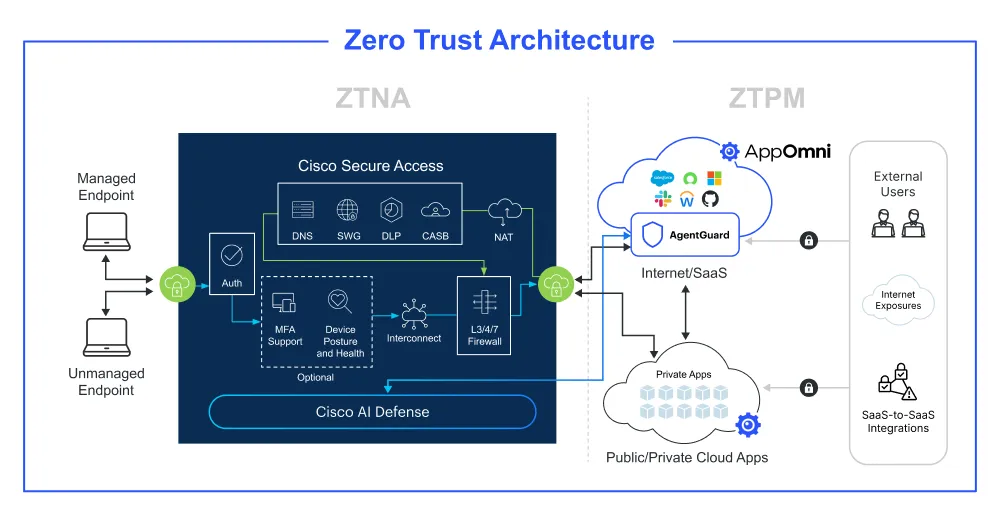
AppOmni extends Zero Trust beyond your network and infrastructure levels into SaaS applications with Zero Trust Posture Management (ZTPM™). It closes critical gaps at the application level, such as misconfigurations in access controls, unchecked privileges, data leaks, or overlooked third-party integrations.

End-to-end Zero Trust Security

Dynamic Policy Enforcement

Strong Identity and Access Protection
Extend your zero trust architecture to SaaS apps & data
Zero Trust (ZT) is an effective framework that secures today’s distributed organizations by leveraging continuous verification and the principle of “never trust, always verify” — regardless of network boundaries. Ensure Zero Trust doesn’t stop at the network edge.
How AppOmni bridges a critical gap in network-centric Zero Trust (ZT) architectures
Protect with continuous visibility and monitoring
Monitor user activities and application configurations continuously with identity-aware context. Manage user roles with principles of Zero Trust Posture Management, including role-based access control, permissions and entitlements management, and data access in complex SaaS deployments.


Ensure least-privilege access control
Go beyond coarse-grained access controls such as group memberships to set up controls based on the principles of zero trust for granting access based on explicit permissions and the precise requirements of the user’s role and the context of the access request.
Secure third- and fourth-party SaaS integrations
Inspect connections from your monitored SaaS apps to other SaaS apps to ensure that they don’t introduce vulnerabilities or bypass ZTPM controls. These actions effectively extend the Zero Trust framework to encompass SaaS-to-SaaS interactions.

Critical applications secured
Protect data essential to your business

Microsoft 365

Salesforce

ServiceNow

Workday

Google Workspace
Get Started
See security in action
Schedule a personalized demo and see how AppOmni closes every AI security gap across your SaaS environment.